Several tilesets
The tileset list: entry types, pausing, hiding, a level of detail per tileset
The main panel holds a list of tilesets. They stream together, around the same scene origin and the same camera: a drone scan inside the city model around it, a point cloud over a globe with imagery.
Entry types
| Type | Source |
|---|---|
| 3D Tiles | A tileset.json URL, or a local path. |
| Cesium ion | An asset id and your access token. The token is only sent to Cesium ion. |
| WGS84 globe | A bare globe to drape imagery on. Its Raster overlays box is ticked for you. |
| Quantized-mesh terrain | The layer.json URL of a terrain server. For Cesium World Terrain, use a Cesium ion entry. |
Ion, globe and terrain entries need the cesium-native backend.
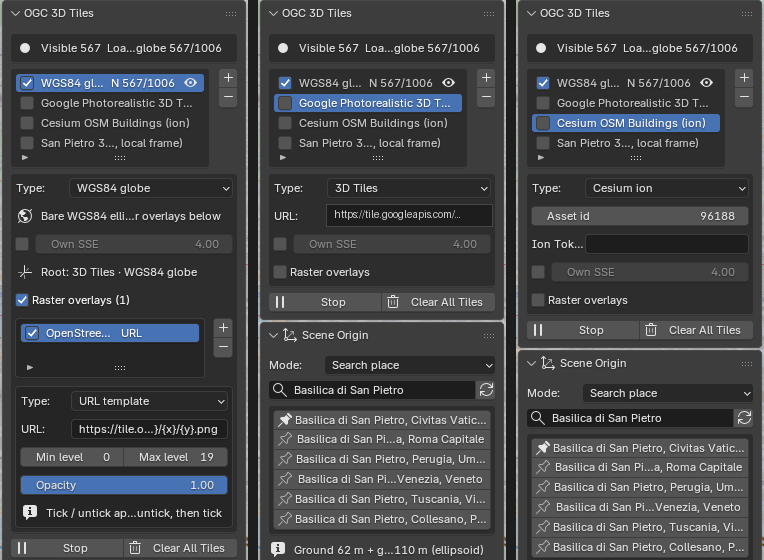
Working with the list
- + adds an entry, - removes the selected one. Entries added, ticked or removed while streaming are picked up at once.
- The checkbox of a row pauses that tileset: nothing more is loaded or unloaded, and what is loaded stays.
- The eye hides it, as in the outliner.
- Editing the URL of a running entry restarts it with the new URL.
- Each tileset has a root Empty,
3D Tiles · <name>, and a collection,Tiles · <name>. Move, rotate or scale the Empty to place the tileset; streaming follows.
A tileset of tilesets
A tileset.json can be nothing but a tree of grouping tiles whose leaves are other tilesets, one per
dataset: every survey of a city, every dataset of a server. With the cesium-native backend each of
those datasets gets its own Empty under the tileset's root, named after the dataset, and its tiles are
parented to it. The grouping tiles get none.
- The Empty appears with the dataset's first tile, at the dataset's centre, with its Z along the local vertical. Its location, rotation and scale start at zero: what you type there is an offset. Location Z is a height offset, for a dataset whose heights are above the geoid among others above the ellipsoid.
- The offset is kept on the tileset's entry, per dataset URL, and saved with the .blend. It comes back after a Stop, a reload, or with a dataset that loads later.
- Level of detail and culling follow the offset. cesium-native only knows where the dataset says it is, so a moved dataset is also selected for a camera moved the other way, as one more view of the same stream. Measured on a splat dataset moved up 100 m under a camera 200 m above it, looking towards the horizon: without that view 45% of the splats that should be on screen were missing, with it none. The price is some detail in excess, since the tiles of the unmoved view load too. Up to six different offsets are followed per tileset, those of the datasets with most tiles first.
- The names of the Empties also serve the scene origin: its Dataset mode puts the origin at the dataset picked by name. See Scene origin.
- An Empty per dataset, under the tileset's boxes in the main panel, turns this off for the tiles loaded from then on.
- A tileset that pages its own hierarchy through external files, as Google Photorealistic 3D Tiles does, has no datasets and gets no extra Empty.
Level of detail
Max SSE (LOD / Streaming panel) applies to every tileset, live. Lower is finer and heavier. Tick the checkbox next to Tileset Max SSE on an entry to give that tileset its own value.
The value is the error a tile declares, in screen pixels, so what a number looks like depends on the data and on the tool that tiled it:
- on Google Photorealistic 3D Tiles at 8 px, the median triangle edge measured 3.3 px;
- a COPC point cloud that declared more error than its point spacing (1.2 px between points at 3.2 px of error) looked fine at 16 to 32 px.
The view that selects the tiles can be another camera than the one you navigate with: see Rendering.
Details
- Two entries with the same name get separate collections (
... - 2), and the entry is renamed to match. - Share links (
/s/<token>/<asset>.json) are labelled by the asset, never by the token. - Start discards the tiles a previous Stop left on screen.
- Load order: missing ancestors first, then shallow tiles, then by screen-space error weighted toward the centre of the view, as CesiumJS does. With the pure Python backend, Foveation cone and Edge SSE relax (Advanced) tune that weighting.